Badger - Virgin Islands to the UK
We left the British Virgin Islands on 23 May 1984 and headed due North. In fact our course towards Shelburne, Nova Scotia, took us directly across Bermuda, so that we had to make a slight detour to avoid that particular hazard. Although we had our fair share of light winds, we were only headed for about 3 days, which is pretty good going by our standards. The only rough weather we had was a short-lived blow that lasted for about 22 hours and forced us to put some clothes on.
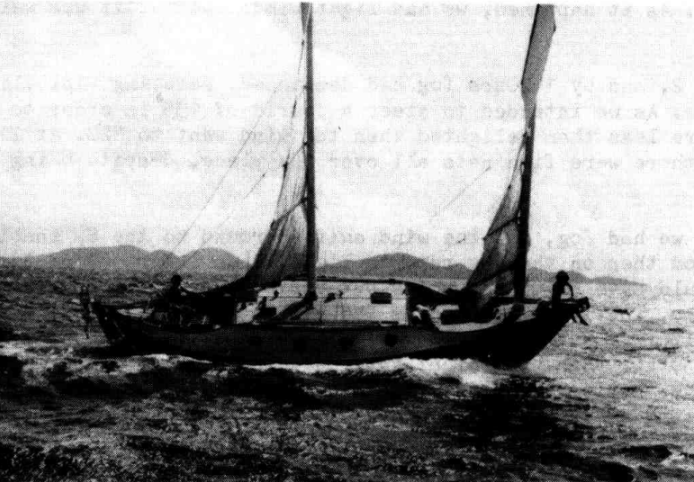
As we entered the Labrador current, our days of naturist sailing were over! Approaching Shelburne, there were fishing boats everywhere, and very light winds. On one occasion, Pete had to start the engine to motor out of the way of a fishing boat that appeared to have every intention to run us down, in spite of the fact that we were burning our masthead light at the time. We arrived at the mouth of the inlet into Shelburne at dawn and spent a long time drifting down in the near calm.
As we approached the harbour we dropped the sails and started the motor, tying up alongside a 60’ schooner from San Francisco. We had family friends at Shelburne who made us extremely welcome and fed us lunch and dinner all the time we were there. One of the things that they did was to make a passage along their many bookshelves and clear out a vast number of good paperbacks for us to read. It was especially welcome to receive such a number of quality books, as generally we seem to end up with a diet of thrillers.
On the 12 June, we regretfully took our leave of Shelburne, sailing up over a couple of days to Lunenburg. It was no hardship at all to wait there. As well as getting diesel, paraffin and petrol we also found that vegetables were reasonably priced and good quality, so we bought a sack of onions, a sack of potatoes and half a dozen large white cabbages. With the addition of carrots, apples and oranges, we were stocked up for about six weeks.
On Tuesday 18 June we set off towards Iceland, with quite a deck cargo of drift-wood to help keep us warm. Had we run into bad weather we would probably have had to throw it overboard. As it happened, we had light winds so that it was well worth the risk.
We left in a SE Force 2, and by 1400hrs fog had descended, reducing visibility to a quarter of a mile. As we intended to steer a course of 135 in order to avoid the Grand Bank, we were less than delighted when the wind went to SSE. At 2100 the log reports that there were fish nets all over the place, despite being in 40 fathoms. All the following day we had fog, but the wind shifted round to the SW, enabling us to lay our course.
From then on the log reports light winds ( force 1 or 2), fog or calms. Often we would have bright sunshine but visibility would be only a quarter of a mile or so. The log also reports the visits that were paid to us by various whales and dolphins. Whales are considerably larger than Badger, but they never showed anything other than benevolent interest. The bird life too was an increasing delight. The tropics are fairly empty of bird life, compared with the more Northern climes, and as we had an excellent book to tell us what our visitors were, we enjoyed identifying new species.
On 23 June, the wind headed us and we were unable to lay our course until the 29th. However, the light winds meant that life was comfortable and that we could light the bogey stove, which usually downdrafts too much, when going to windward. Our days were enlivened by such things as sending messages in bottles and baking goodies for tea when the range was on. The wind shifted round to the SW and enabled us to make better progress as it moved through the W into the NW over the next or 3 days.
On July 3 we celebrated Half-Way Day with a slap-up dinner and found ourselves back in the Gulf Stream and somewhat warmer than we’d been for some time. Then the winds fell away again, the fog came back and eventually we were becalmed. The winds never really picked up and we continued to sail in a leisurely manner until we arrived in Reykjavik at 0230 on 17 July. All in all we had taken 28 days to cover 2366 miles - not a record-breaking passage, no doubt, but a very comfortable and interesting one.
We stayed tied up alongside in Reykjavik for 4 days. We really liked what we saw of Iceland. We took a bus ride to Thingvella, the site of Iceland’s first Parliament the first in history and explored Reykjavik itself.
From Reykjavik we sailed to ”Vestmannaeyjar the town of Vestmann Islands on the South of Iceland. We had beautiful weather at Vest-mannaeyjar and climbed to the top of the volcano that overlooks the town. Ten years ago, this same volcano erupted, covering about half the town with lava. The islands were evacuated, apparently without a single casualty, and after 6 or 7 years, the volcano had calmed down sufficiently for people to return and rebuild their town. The flow of lava had partially blocked the original entrance to the harbour, leaving a narrow passage. The islanders say the harbour is now better than ever!
Having seen all we could of Vestmannaeyjar we set off at 1435 on 32 July towards Norway. 13 Shortly after leaving Helmaey harbour, with a rollicking NNW Force 5 wind, we made the mistake of congratulating ourselves on the good start. At 1500 we streamed the log, at 1800 we had done 15 miles, then the wind dropped away so that by midnight we had only done another 16 miles.
We crossed the Arctic Circle on 30 July and celebrated with a slug of Pusser’s Rum apiece and as usual on a celebration day we had a slap-up meal too.
We celebrated a run of 105 miles, the first run of more than 100 miles. Badger’s did 106 the next day, but followed that with 67, just so as we didn’t get too cocky! Badger completed her 4th Atlantic Crossing. Actually, we never found out where the Atlantic Ocean stops and the Norwegian Sea begins, so we decided that we had completed our crossing once we were East of St. Kilda, from where we had started out in 1983.
The winds got lighter and lighter and on the final two days of our passage we sailed only 80 miles. In the end we had the motor on to arrive in Bodø Harbour, where we tied up alongside in the middle of the town.
A couple of days later we set off towards the Lofoten Islands. On a day of very light breezes, we drifted 10 miles in 6 hours to an island called Landegode where we anchored at Kjelbotn. I had done some washing the previous day, which was not yet dry, so I took advantage of the sunshine to hang it out. However, we had only been at anchor a short while when we realised we were in a poor spot for such things. Katabatic gusts swept down the mountainside and before we had time to rescue them, they pulled a towel and shirt off the guardrails - pegs and all into the deep and cold water!
The next day we left for Stolvaer in the Lofoten Islands, some 50 miles away. The first part of the passage was quite hairy, with the wind gusting gale force and some tricky navigation to boot. Pete stayed outside for most of the passage, but I left him to it far too cold for my liking.
We started off towards Trondheim with a nice NE4, on 19 August after a 5 day cruise in the Lofoten Islands. The wind behaved itself until the evening of the 21 st when it came round to the SW where it remained for the next 10 days.
Trondheim itself was certainly worth visiting; quite apart from its cleanliness and neatness the mixture and variety of buildings was a delight. There were tree-lined streets that one could stroll through, a river running through the centre of the town to sit by and as its crowning glory, Trondhein has the most magnificent cathedral.
On September 1, we set off towards Lerwick, arriving there four days later after a mixed bag of winds.
On the night of 3/4 September we had a hair-raising sleigh-ride down rows of oil rigs in a NNE 6-7 with impressive waves. After the solitude of the Northern Oceans, it was more than a little disconcerting to be able to see more than twenty oil rigs at one time. Lerwick was delightful and we would have liked to linger, but a fair wind for the Hebrides beckoned, so that we stayed only one night before using a NW Force 6 to boost us on our way.
We kept our fair winds for most of the way to Lock Leurbost on Lewis and indeed had to jill around until dawn before entering on Monday 9 September.
That completed our round trip of the Atlantic, which started two years previously.
We recorded a total of 16,500 miles in the log sailed in the last 4 months of our time away.
To sum up: we are, of course, very pleased with our little ship and she has proved to be very comfortable both in harbour and at sea. Of the gear that we have on board, I would praise extremely highly our Aries self-steering gear and our Aquair wind/water generator.
The Dickinson diesel range is wonderful, and the solid fuel stove a necessity. We’ve been very pleased with our Zeiss yacht sextant and had no problems with our Seafarer echo sounder or RDF, though to be honest, we’ve hardly used the latter. I would recommend acrylic as a sailcloth. Although it is susceptible to chafe, this will be remedied before we leave again.
As for the junk rig, we both agree that we would find it extremely difficult to go back to cruising a monohull with any other rig. In a nutshell, the Chinese knew a thing or two! We are also more than satisfied with the construction of the boat and would definitely build in wood/epoxy if we were to do it again.
Our plans? Subject to change at a moment's notice. Summer in Scotland, thence to Portugal, Madeira, Canaries, Brazil, Uraguay and points South. Don’t hold us to it.
Annie and Pete Hill